
Marriage Record
The parish priest kept a record of all marriages conducted in the parish. Before 1784 the records for all of the villages in the parish were kept together. After 1784, the priest kept all the villages separately. They may have been bound in the same book, but a separate listing for each village was organized alphabetically by village, year by year. When searching for ancestors, never concentrate solely on one village, or even one parish for that matter. Although it’s commonly thought that people never moved great distances outside their birth village, you will find people often marrying into families in neighboring villages and/or parishes. Explanation of each column 1. Numerus Serialis or Nr. posit. (Serial Number or Position Number)
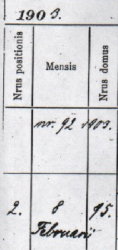
The priest numbered each marriage record sequentially (1, 2, 3, etc.). Each year the priest started over with number one. This was done to show that no one’s marriage could have been added or removed at a later date. This simple information can be used by the genealogist to help cite information for your own family history. This extra citation will ensure your proper record keeping. Of course, it is not essential. However, if you would like this extra "protection", especially if the birth record contains names in a foreign language, in particular a foreign alphabet, you may do this. Furthermore, by tracking the sequential numbering of the marriages, one can determine any missing pages or pages out of order (which sometimes happens when researching microfilmed copies that may have been microfilmed out of order). On some forms, this information is not found. On this example above, this marriage was the 2nd in the year 1903.
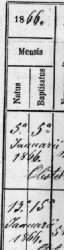
2. Dies et Mensis Natus et Baptisatus (Day and Month of Birth and Baptism)
You should note both of these dates and not just the birth. Many genealogists concern themselves only with the actual birth date. However, one should keep both. Sometimes you may find ripped pages or pages not properly microfilmed where you’ll only find one of the dates. Make sure that you mark it correctly as either the birth or the baptism, depending on which one of the two is present. Be careful when noting the month and year. Often the month and year is not written for each and every person’s listing, only the date. Carefully backtrack to the last month and year listed. Do so carefully so as to not skip a month or year and mark the wrong one down. Be careful of this especially when researching at an archive where photocopying is not available. Unlike using microfilm at a local Family History Center, you may not easily have a chance to return to the originals to verify your note-taking. The months will usually be in Latin. This should not be a problem if the month is written out as the Latin resembles the English. In older Greek Catholic records, you may find the month in Church Slavic. Again, this will be easy IF you can read the Cyrillic alphabet since the Church Slavic terms also resemble the English. For a list of months in different languages, visit my page on months. Note the confusion over the written number of the month, in the case of 7-bris, 8-bris, 9-bris, and 10-bris (or 7ber, 8ber, 9ber, 10ber). These are NOT the numbers correlated to the way we count months today! They are based on the old calendar where the first month of the year wasn’t January, but March. This makes sense if you look at the Latin meaning behind these four months. Study the roots of these months:
"Sept" stands for Seven (7) in Latin. Therefore:
"Octo" stands for Eight (8) in Latin. Think of the word "octagon" "Novem" stands for Nine (9) in Latin. "Decem" stands for Ten (10) in Latin. Think "decade" or "decagram" Therefore: 9-bris is November, not September 10-bris is December, not October
Poland adopted the Gregorian Calendar (the one we use today) in 1582. The Greek Catholic church records were kept in the Gregorian Calendar. This is different than record keeping in neighboring Russian Empire, which kept the Julian Calendar until 1918. Depending on the year, there is about a two week difference between the two calendars. After the tsar’s government ended, the newly formed USSR adopted the Gregorian Calendar. So, the day after January 31, 1918 was February 13, 1918. (In the mid 1800’s, the difference was usually 12 days.) As a side note, some branches of the Orthodox church today still officially use the Julian Calendar. As you can see, this makes for easier research in Halychyna/Eastern Galicia than it does for our genealogical colleagues researching ancestors in the Russian Empire.
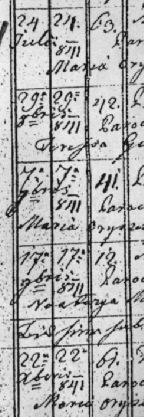
3. Numerus Domus (House Number)Click here to see a detailed description, important usage, and often misunderstood column House Number.
4. Sponsus (groom) and Sponsa (bride)Under each of these two main columns are the following
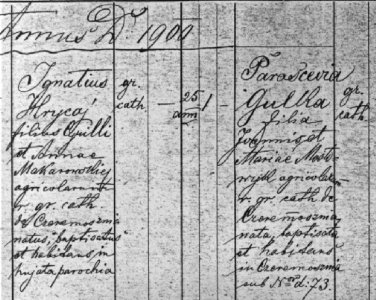
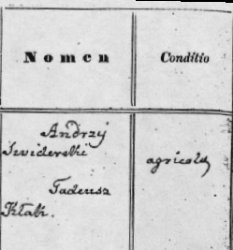
columns: Here is each of the categories listed for both the groom and bride. Nomen (Name) The amount of information that can be found in this column varies from year to year, parish to parish and priest to priest. The potential for a great wealth of information from one marriage record is great. Of course, earlier years will include less information as a general rule. Some of the early records of the beginning of the 19th Century list only the groom’s and bride’s name. As the years went on, the priest in the parish of Biały Kamień/Bilyi Kamin (both Roman Catholic and Greek Catholic) began to include more information, such as the parents of the newlyweds. Look for these Latin terms:
These Latin terms would then require the genitive case of the following name, so you must be careful about noting the correct name. See more detail as to grammar and its effect on the language, in particular on proper names, in my section on languages. Sometimes, you may find the priest noted the maiden name of both the groom’s and bride’s mother. For showing maiden names, you may find these various
Latin terms:
Pay particular attention to the names of the spouses. Remarriage was very popular in the event of a spouse’s death. Reasons based on financial, social and religious well being vary for the individual. The surname listed for the woman may be her maiden name, the surname of her first husband, or the surname of her current husband. In turn, you must be careful of these names in the future. A woman may be referred to in future records of her children’s and grandchildren’s births, marriages, and death records with her own maiden name, the first husband’s surname or current surname. A thorough study of all of the woman’s ancestors, even of the entire village, is necessary in order to track this properly. Of course, as always, you must be aware of the possibility of priest error, or copy error when looking at the Bishop’s Copies. Other information the priest might include, if you’re lucky, pertains to birthplace, current residence, and occupation. Look for these Latin terms for such information:
Other Latin terms you may find in this column that may be
of help: Examples illustrating the above points:
Groom: Bride:
Religio (Religion)
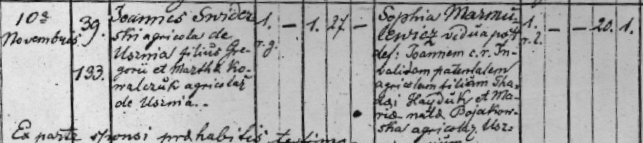
This is self explanatory. Sometimes, you may find the abbreviation "r.l." or "r.g." in this column or next to the person’s name. This stands for Latin Rite (or Roman Catholic) for the first, and Greek Rite (or Greek Catholic/Ukrainian Catholic) for the second. In the example above, in the column just to the right of the groom Joannes Swiderski (Ivan in Ukr.) is the abbreviation "r.g.", which stands for Greek Catholic. In the column just to the right of the bride Sophia Marmulewicz (Zofia in Pol.) in the abbreviation "r.l.", which stands for Roman Catholic. Sometimes, the religion is written out:
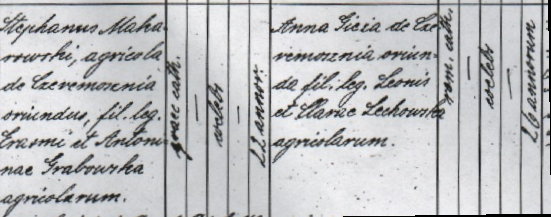
The groom on the left is listed as graeco cath. (Greek Catholic) while the bride on the right is listed as rom. cath. (Roman Catholic). The names read:
Coelebs / Viduus (for the Groom) (Unmarried / Widower)
and The priest will check one of these appropriate columns. Pay particular attention to the newlyweds who are widowed. Look carefully at the information found in the Nomen (Name) column to determine any information on the previous spouse.
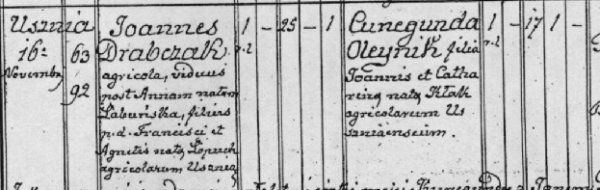
In the example above, the column just to the right of the groom's age (25 yrs.) is checked, which on this document means he was a widower. However, the column just to the right of the bride's age (17 yrs.) is checked, which on this document means she was never married before. Here is the translation of the text in the name columns for both:
This is self explanatory. Sometimes, I have even seen the priest write the specific date of birth for both the groom and bride. (What a bargain!). Of course, be very careful about taking the priest for his word. The priest may have been a few years off when recording this information. As always, there could even have been a copying error by the priest, especially when studying the Bishop’s Copy. 5. Testes (Witnesses)
|
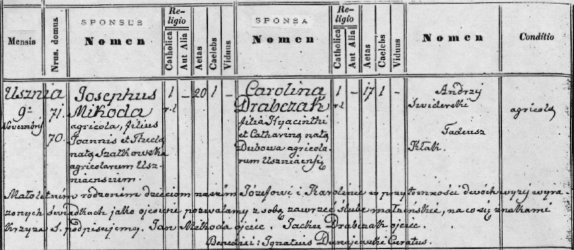
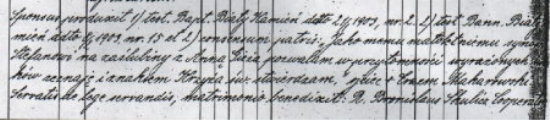
 This paragraph comes from the bottom of the record that is pictured at the very
top of this webpage. It is roughly translated as "For our own young
children Jozef and Karolina in the presence of the two above mentioned
witnesses, as well as to the permitting fathers contract the marriage, to which
we make sign the marks of the cross. Jan Mikoda, father, and Jacku
Drabczak, father. Signed by the priest Ignacy Dunajewski.
This paragraph comes from the bottom of the record that is pictured at the very
top of this webpage. It is roughly translated as "For our own young
children Jozef and Karolina in the presence of the two above mentioned
witnesses, as well as to the permitting fathers contract the marriage, to which
we make sign the marks of the cross. Jan Mikoda, father, and Jacku
Drabczak, father. Signed by the priest Ignacy Dunajewski.|
www.halgal.com
Questions and Comments to Matthew
Bielawa |