House Numbers
as found on vital records
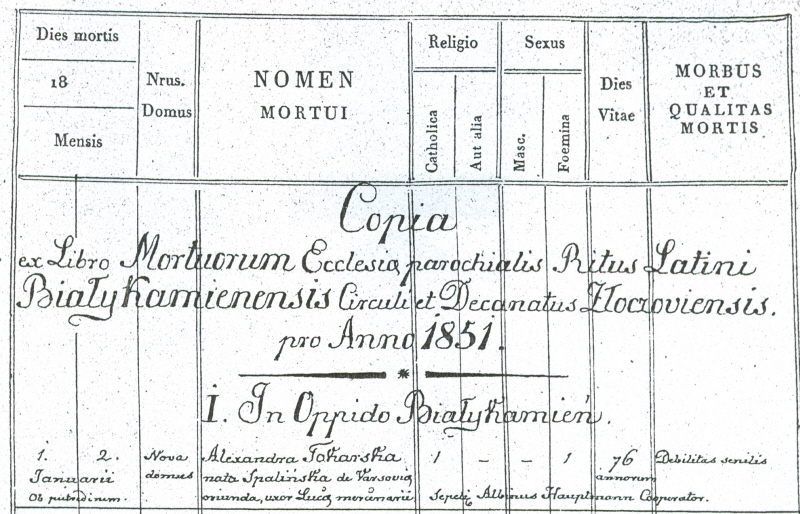
One of the most interesting features of the records from
Galicia/Halychyna during the years of the Austrian rule (1772 – 1918) is the
House Number.
The House Number is the number of the house where the
particular event took place, e.g.. birth, marriage or death. One can quickly run
down this column and look for specific house numbers to easily find ancestors.
Also, it’s a great way to track movement of families within the village.
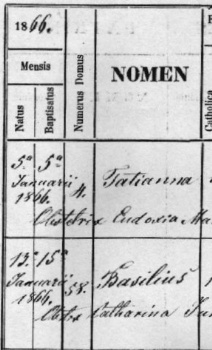
(example of house number in birth record. The top
birth record shows house number 4, and the second, house number 58. Both
in the village of Cheremoshnia/Czeremosznia)
Often, a house was occupied by several families. One can
easily find other families living in the same house as your own ancestors. This
clue would take you to research that other family’s line back to see if there is
a connection to your own family. Without seeing the House Number, you might not
have known to take this course of action.
House Numbers were usually assigned chronologically, with
No. 1 being in the center of the village or near the church or at one end of the
village. The numbers increase as they numbered the houses out from the center or
church or across to the other end of the village.
As a new house was built, it got the next number in
sequential order. As you can imagine, soon the order of the numbering lost it’s
specific geographic location. So, House Number 95 may be on the opposite side of
the village from House Number 96. Earlier numbers, though, maybe next to each
other if the houses were next to each other at the time the numbering system for
that village was developed.
There are certain misconceptions about the House Number
that must be mentioned. One should not jump to conclusions or over estimate the
real value. Keep in mind that many births occurred at a neighbor’s, relative’s
or even the midwife’s house. Therefore, the house number that was recorded by
the parish priest on the record may not necessarily be the family’s home.
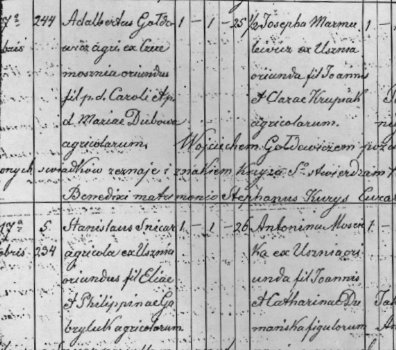
(Top example shows only one house number, Number 244,
which could be either for the groom or the bride. But since the groom is
from Czeremosznia, where the house numbers don't go beyond 110, this is most
likely the house number of the bride, who is from Usznia where such high numbers
exist. The second example shows two house numbers, 5 and 234.
The usual case is the first number is for the groom and the second for the
bride, but that can never be taken as an absolute rule.)
For marriage records, many times only one House Number
was written down by the priest. Though my experience shows that this was usually
the groom’s House Number, it was not always so. Sometimes, the House Number
didn’t belong to either of the married couple, making me wonder where the
connection is. Could it be a priest’s error? Could the error have been made when
a duplicate copy of the registry was written for the Bishop’s Consistory (such
copies were known as the "Bishop’s Copies")?
One should never look ONLY at the House Number for
ancestors in the parish books. You must also check names, of course.
In most cases, this House Number was abandoned long ago
before anyone living can remember. However, there is an exciting source of
records available, known as Cadasters, which can expound on the House Number as
well as lead to more ancestors. I personally feel that these records bring all
of the vital records to life.
Personal Account
When I visited the village of my ancestors, I asked
several people about the House Numbers. No one remembered any of the house
numbers assigned during the Austrian rule. However, some residents did remember
that the numbers assigned in the years between the wars, when the region was
controlled by Poland, replaced a previous system. However, after WWII, the
houses in these three villages were changed yet again. Some of the older
residents even remembered their own House Number from before the Second World
War.
With the information found on the cadasters and on the
associated maps, I was able to follow the streets of my ancestral village since
they did not change at all in the last 160 years!! I was able to walk up and
down the streets and know exactly who lived in these houses over one hundred
years earlier. Of course, most of the houses were newer, as the village was the
scene of some of the most fierce fighting during WWII. However, from meeting the
residents, I discovered that often the SAME family lived in the house.
For more information on cadasters,
read my article on the TsDIAL, the Central State Historical Archive of Ukraine,
city of Lviv. The article covers the archive's holdings, policies and
procedures, as well as an interview with the director Dr. Diana Pelts, click on
the link below. I wrote this article for Rodziny, official publication of
the Polish Genealogical Society, Summer 2001 issue.
You'll need Adobe Acrobat Reader to read the article.
If you don't have a copy of this installed on your computer, you can download a
free copy from
the Adobe site.
You can view a "no frills"
copy of the article. This copy does not include any of the graphics
and pictures which appear in the PDF format from the original publication.