Genealogical Gazetteer
of Galicia
by Brian J. Lenius
1st publication in 1993. 3rd edition from 1999
includes Expanded Data
Lenius has single-handedly made our Galician research
much easier with the publication of his gazetteer. Over a period of several
years, Lenius collected data from over 20 various sources, cross checked the
information and compiled a complete listing of place names found in what was the
Austrian province of Galicia.
With such a resource available, few can realize the chaos
that once was when one tried to find basic information on an ancestral village.
One needed to do all of this collecting and cross checking of information to
learn the basic information from several gazetteers—a task made difficult not
only due to language barriers and understanding the mechanics of each gazetteer,
but due to the obvious difficulty of locating these often hard-to-find
references. Lenius, in cross checking the various references, discovered errors
to which he calls the readers attention.
There’s no other gazetteer that contains all of this
information in one place, which makes the Genealogical Gazetteer of Galicia
valuable to both the beginner and advanced genealogist.
There are several sections in the Lenius gazetteer that
are devoted to various unique aspects to Galician place names.
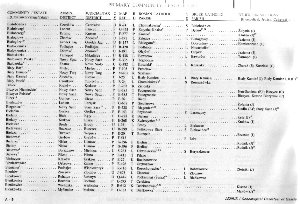
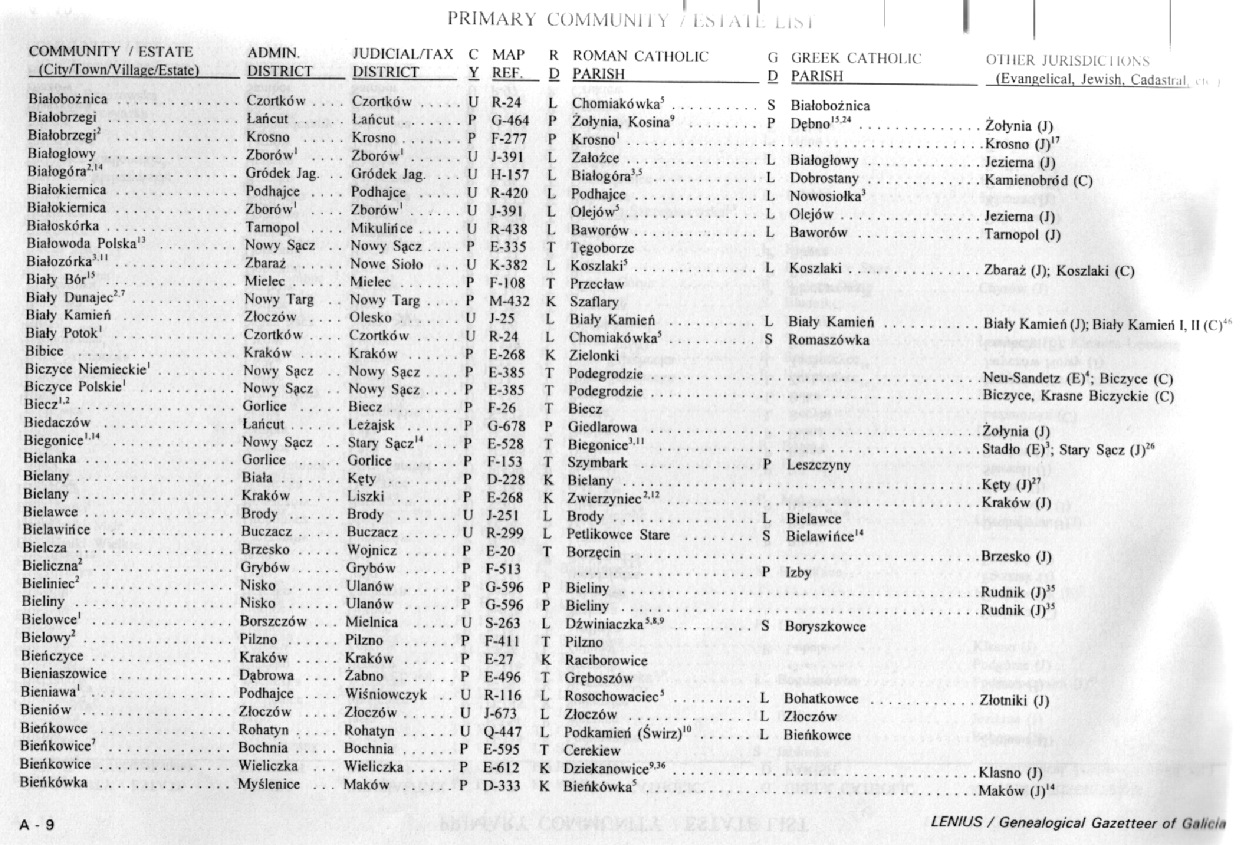
First Section: Primary Community/Estate List
The first and largest section is the "Primary
Community/Estate List". It contains 6,3000 communities and estates. The list of
localities contains mostly the Polish spelling, even for those found in modern
Ukraine and which had a Ukrainian majority during the Austrian years. This is
common as most gazetteers, even from earlier years, used the Polish spelling,
which illustrates the strong political influence the Poles, even though a
minority in Western Ukraine/Eastern Galicia. Sometimes German names are used for
German colonies and for larger towns and cities.
In this section for each of the localities there is
listed:
The Administration District during the period from
circa 1896 to 1914. Any differences or discrepancies are indicated in Lenius’
extensive endnotes.
The Judicial/Tax District, again during the period
from about 1896 to 1914. This structure was a sub-district of the Administration
District. Again, any differences and discrepancies are indicated in Lenius’
extensive endnotes.
Current Country lists in which country (Poland or
Ukraine) the locality is currently located. the author warns that the
information was based on the Roman Catholic parish, which may have been split in
two by the two countries.
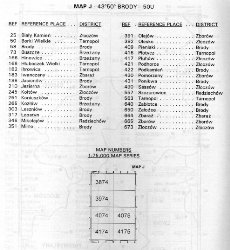
Map Reference corresponds to the locality’s (or
it’s nearest locality with a post office or telegraph station) location on the
maps found in the back of the gazetteer. Although the map is not detailed, it is
easier to first find the locality on these maps in order to get one’s bearings
before attempting to find the village on a more detailed map.
Roman Catholic Diocese indicates to which Roman
Catholic archdiocese or diocese the village’s Roman Catholic parish belonged.
Choices are:
- Archdiocese of Kraków (Krakiv in Ukr.)
- Archdiocese of Lwów (L’viv in Ukr.)
Diocese of Przemyśl (Peremyshl in Ukr.)
Diocese of Tarnów (Tarniv in Ukr.)
Roman Catholic Parish lists the Roman Catholic parish to which the
village belonged circa 1906.
Greek Catholic Diocese indicates to which Greek Catholic archeparchy
or eparchy the village’s Greek Catholic parish belonged. Choices are:
- Archeparchy of L’viv (Lwów in Pol.)
- Eparchy of Peremyshl (Przemyśl in Pol.)
Eparchy of Stanislaviv
(Stanisławów in Pol. Now known as
Ivano-Frankivsk)
Greek Catholic Parish lists the Greek Catholic
parish to which the village belonged circa 1906.
Other Jurisdictions lists at least 6 possible
various jurisdictions for Armenian Catholic Parish, Land Cadastral Community,
Evangelical Lutheran/Reformed Parish, Jewish Registration District, Mennonite
Circuit, Orthodox Parish.
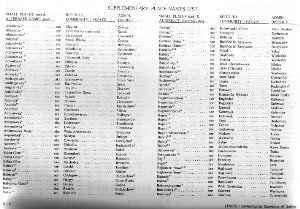
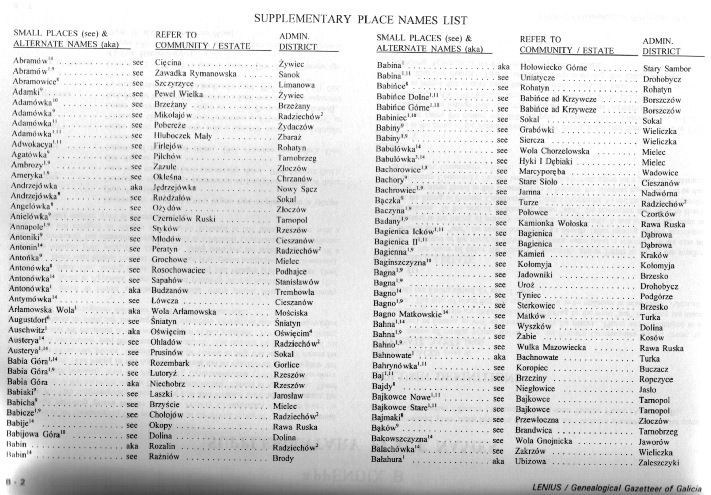
Second Section: Supplementary Place Names
This list includes 3,441 smaller localities not covered
in the first section "Primary Communities/Estates". If your smaller locality is
not found in the first section, you can check this supplemental list, which will
lead you to find the larger village or town to which it may belong.
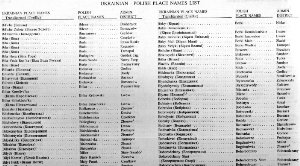
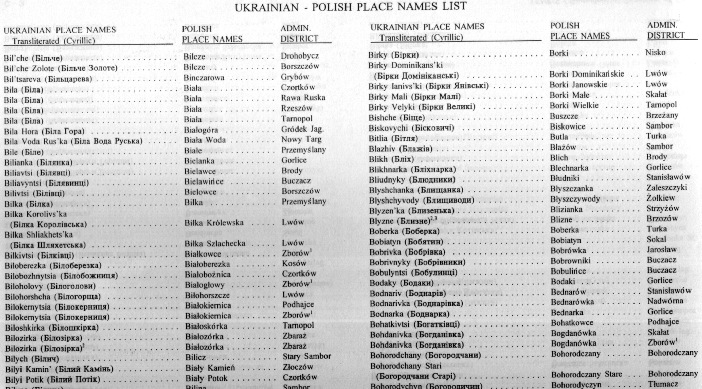
Third Section: Ukrainian Place Names
The "Ukrainian Place Names" list contains 4,052
localities, mostly from this website’s focus on Western Galicia/Eastern Galicia.
The listing is sorted alphabetically by the transliterated Ukrainian. Along with
this transliteration, one will find the Cyrillic spelling, corresponding Polish
variation, and the Administrative District to which it belonged circa 1896 to
1914.
This section is especially valuable to those who only
know the village’s Ukrainian spelling which may not have an obvious Polish
variation. One could first search this section before heading to the first
section "Primary Communities/Estates" to find all the more detailed information.
For the Polish researcher, this section is important to
find what the proper Ukrainian spelling is of the village/town, which you’ll
need to know when using modern Ukrainian maps, contemporary gazetteers,
websites, or personal visits to Ukraine to either archives or the very village
itself.
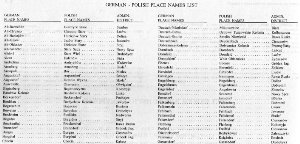
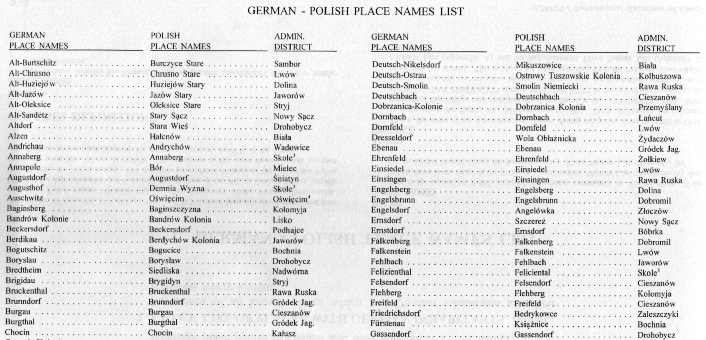
Fourth Section: German-Polish Place Names
This list, containing 232 German language place names and
their equivalent Polish names. This information is invaluable to the researcher
who only knows his/her ancestral village in the German form. From here, such a
researcher can learn the Polish and Ukrainian variations which are needed for
other resources such as vital records, gazetteers, maps etc.
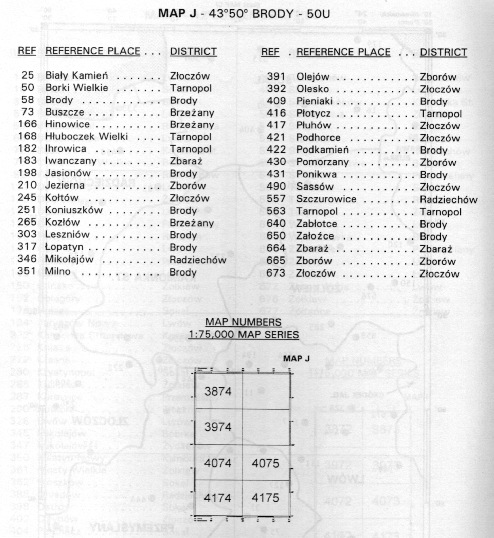
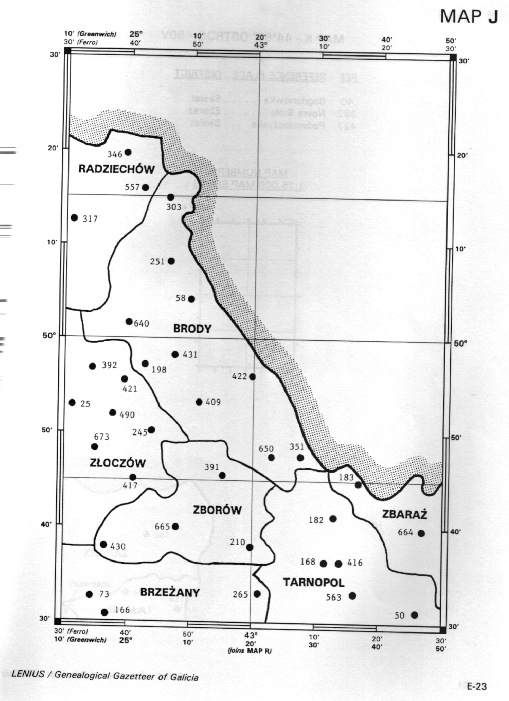
Fifth Section: Maps
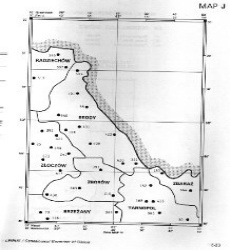
These maps should be used in order to determine the
general area of the smaller villages. Although these maps are not detailed, you
can use them to locate the villages relation to larger towns, which allows you
to find the village on larger, more detailed maps with ease and speed.
For information on purchasing your own copy of this
excellent resource, please visit Brian Lenius' webpage:
GazetteerOrderForm.htm. It really is a "must-have"!
|