Death Record, Part 2
5. Religio (Religion)
Catholica/Accatholica or
Catholica/Aut Alia (Catholic/All Others, here "Non Catholic")
This is self explanatory. Sometimes, you may find the
abbreviation "r.l." or "r.g." in this column or next to the person’s name. This
stands for Latin Rite (or Roman Catholic) for the first, and Greek Rite (or
Greek Catholic/Ukrainian Catholic) for the second.
6. Sexus (Sex)
Masculinus/Femininus (Male/Female)
This is self explanatory. This information can be used to
help you identify the sex of the name, which may be useful to someone not
familiar with Latin (or Polish/Ukrainian) first names. Also, it can be
useful if the handwriting of the name is not clear, or if the page near the name
is smudged, torn or badly microfilmed. Two common names are often misinterpreted
by researchers taking notes too fast or sloppily: in Latin, Franciscus and
Francisca, which in Polish are Franciszek and Franciszka and in Ukrainian
Frantsishek and Frantsishka, and in English Francis and Frances.

The priest indicated the age of the deceased. You may
find the age in years, months, weeks, or even days.
Look for these Latin terms:
annorum, an, anno, anni = year(s)
mensis, mensium = month(s)
die, dies, dierum = day(s)
hebs, hebdomadum = week(s)
Understand that the priest was not always correct in the
information that he wrote, especially in terms of older people. When you are
trying to track down a birth record based on the information you learn here in
the death record, do not check only down to the EXACT year or month it would
have been. Give yourself some space to check a few years/months before and after
this date the priest put on the death record.
In this example, they read from top to bottom:
72 years of age;
90 years of age;
3 years of age;
6 days of age;
67 years of age;
9 months of age
One will usually find Latin terms, but may find some
Polish and/or Ukrainian. The priest did not always include details on the death
(nor could not have due to the lack of serious medicine and treatments in the
rural villages of earlier centuries). So, one often finds terms such as:
|
Naturalis |
Natural |
|
Ordinaria |
Ordinary |
|
Variola |
Various |

One can easily see the occurrences of epidemics caused by
various deadly diseases common to rural areas such as Galicia/Halychyna in
earlier centuries. Such deadly diseases are cholera, diphtheria, typhus.
Especially sad to see are the diseases that took the lives of so many of the
young children, such as scarlet fever (Latin: scarlatina), measles (Latin:
morbile)
In addition to the high infancy death rate, one finds a
high death rate of women during their child’s birth, listed often in Latin as
Partus Difficilis
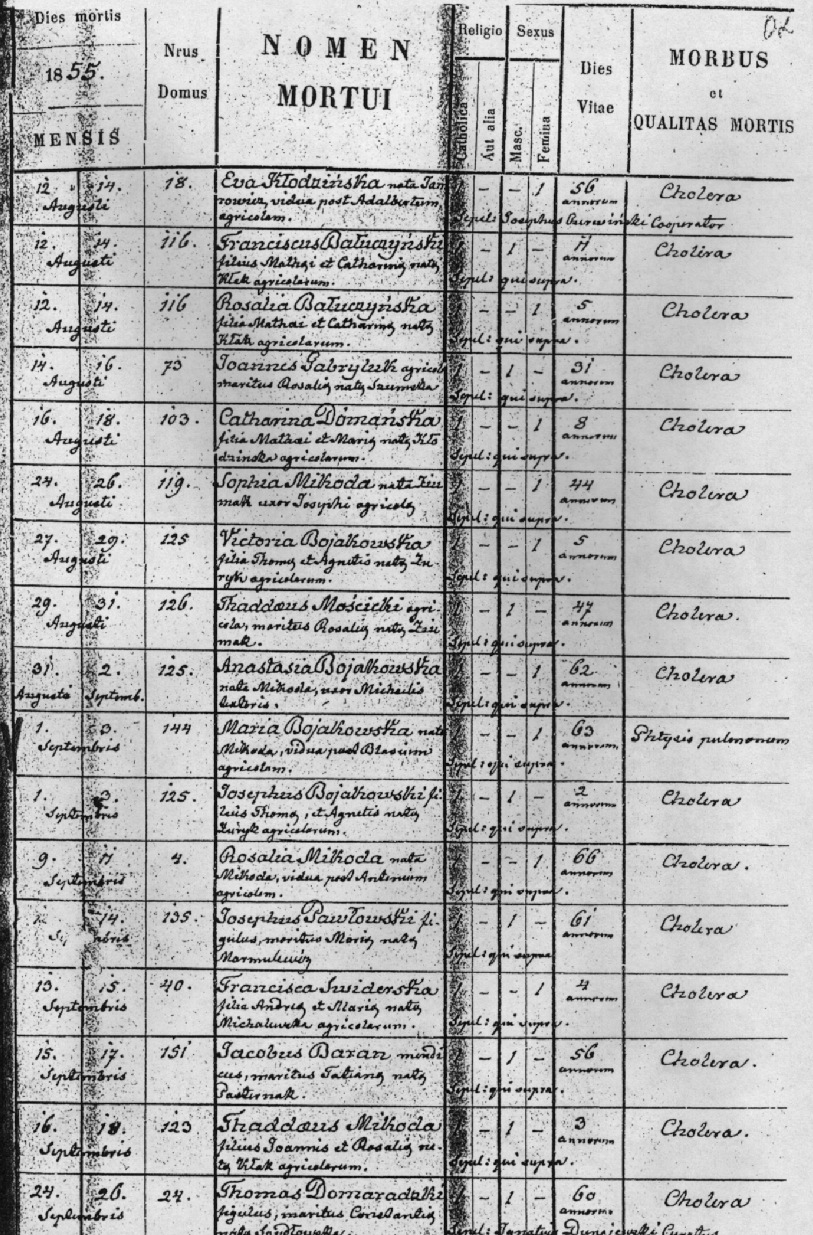
To view the recording of a terrible cholera epidemic,
click
here or on the picture to the
right for the complete page.
In the village of Czeremosznia at the end of August 1889,
I found the sad tragedy of an entire family except for the husband. The
priest wrote: "ze spozycia jadowitych grzybów
otruta". A mother and her four children died of eating poisonous
mushrooms.
The priest may have written in the person who buried the
remains of the deceased. He often used the term "sep." followed by the person’s
name.

In this example, the priest signed his name Ignatius
Dunajewski. In the second burial listing, you see he wrote "Sepul qui
supra". The Latin term "qui supra" means that the information is repeated
from the line above.
Return to Death
Record, Page 1