|
|
Genealogy of Halychyna / Eastern Galicia |
www.halgal.com |
|
|
|
|
|
|
A History of Cities and Villages of the UkrainianSSR
Published in Ukrainian as "Istoriia mist i sil Ukrainskoi RSR"
"Історія міст і сіл Української РСР"
Published in Russian as "Istoriia gorodov i sel Ukrainskoi SSR"
"История городов и сел Украинской ССР"
Some province/oblast volumes are now available online!
Russian language version of several provinces/oblasti, including Lviv can be found at http://ukrssr.ru. Simply click on the province/oblast' on the map of Ukraine to open up the volume to pull up a list of each chapter. Note the color codes on the map indicate if the volume is "Ready/Available" (colors green and yellow.)
Several other various copies can be found throughout the
internet. To make it easy for you to search, copy/paste either the
Ukrainan or Russian text below into your favorite browser (like
www.google.com)
and search away!
- "Історія міст і сіл Української РСР" <Ukrainian>
- "История городов и сел Украинской ССР" <Russian>
A massive project began by the Central Committee of the Communist Party of Ukraine to publish a 26 volume series (one volume for each oblast (Ukrainian for province) of the Ukrainian Soviet Socialist Republic) covering the history of all cities, towns and villages in the republic. The 26 volumes were published over the period 1967 to 1974. After 1974, the volumes were reprinted in Russian.
Over the course of its publication, over 100,000 people were involved with gathering data and offering it for inclusion into the volume. The collection is hard to come by in North America. (John Pihach informs me that some university libraries have all the volumes of this publication. Interested persons should conduct a search through a local library's ILL (Inter-Library Loan) system. I found my copy of Lviv oblast in an open air market in downtown Lviv.
There was only one copy of this one oblast. The man who sold it to me forgot where he got it and did not know how to get any more copies of either this oblast' or any other. He suggested I try an open air market in Ternopil for the volume on Ternopil oblast!
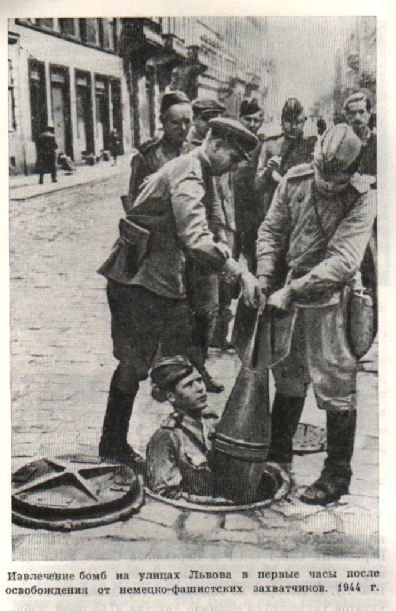
When using this reference, one must keep in mind that it was written during the Brezhnev years. Upon the completion of the entire series in 1974, an article appeared in the Ukrainian Historical Journal about the initial genesis of the project and its progress through to publication. The article states that the city, town and village descriptions were drawn "from a party-class position...the common historical fate of the Russian and Ukrainian people...their struggle against foreign occupiers and exploiters...to uncover the great achievements of the Ukrainian people under the star of Soviet rule, which is the result of the incomparable victories of the socialist ruling order, and the wise rule of the Communist party and its Central Committee..." (quoted from Adrian Karmazyn’s article "A Study of A History of Cities and Villages of the Ukrainian SSR, Research Report No. 46, Canadian Institute of Ukrainian Studies Press, University of Alberta: Edmonton, 1992.)
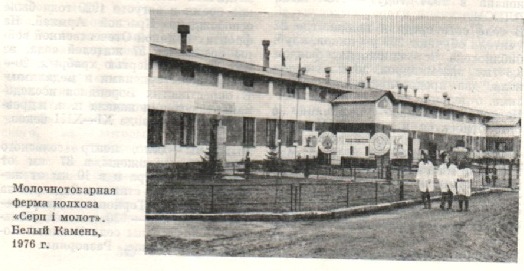
Therefore, it should be no surprise that information found in the book is from a unique prospective, one that many contemporary genealogists may not like or understand. The importance of this series, however, should not be underestimated. The information you can learn from the series is informative and invaluable. The narratives range from a sentence or two about a larger village to many pages about towns and district centers. Although much of the history is taken from the Soviet point of view, there are many references to historical dates, buildings and people outside Soviet context. There are some very good maps and many excellent photographs, some in black-and-white and others in color. Of course, many of the pictures are of Soviet generals, party members, statues and monuments dedicated to anti-fascist and Soviet heroes, and newly constructed factories and collective farms. But you’ll also find pictures of village life and castles, too.
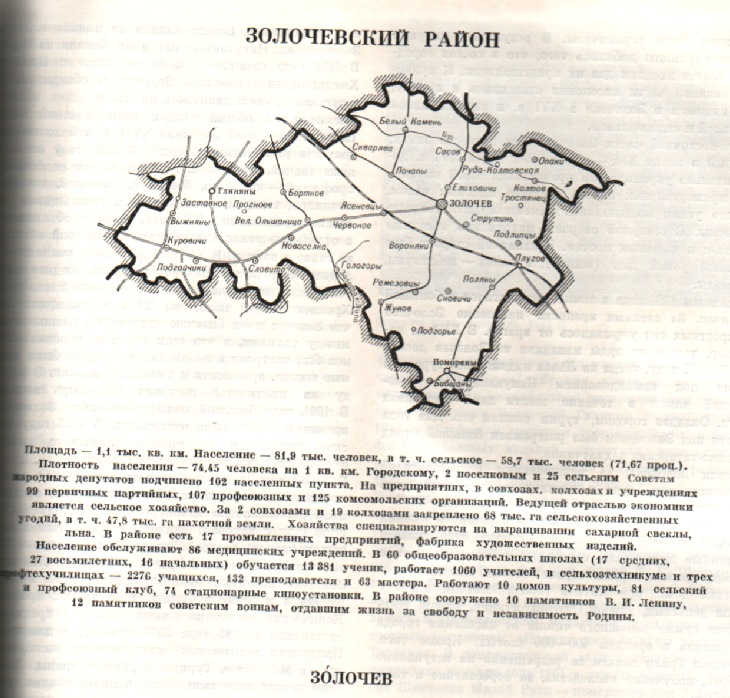
The volume begins with a description and history of Lviv oblast, followed by a detailed history of the city of Lviv. Then each district, arranged alphabetically, is introduced with a general description and history, followed by information on main cities and towns of importance within the district. At the end of each section, smaller towns and villages in that particular district are described. The smaller villages, though not described, are listed to show which town or agriculture center then belong to.
Most historic descriptions list the number of Communist Party members residing in the town or village, along with the number of residents who took part in the Second World War (translated as the Great Patriotic War) and number of casualties from the war.
At the end of the volume is both a Geographic Index and a Person Index, allowing you to search quickly for your city, town or village.
Examples
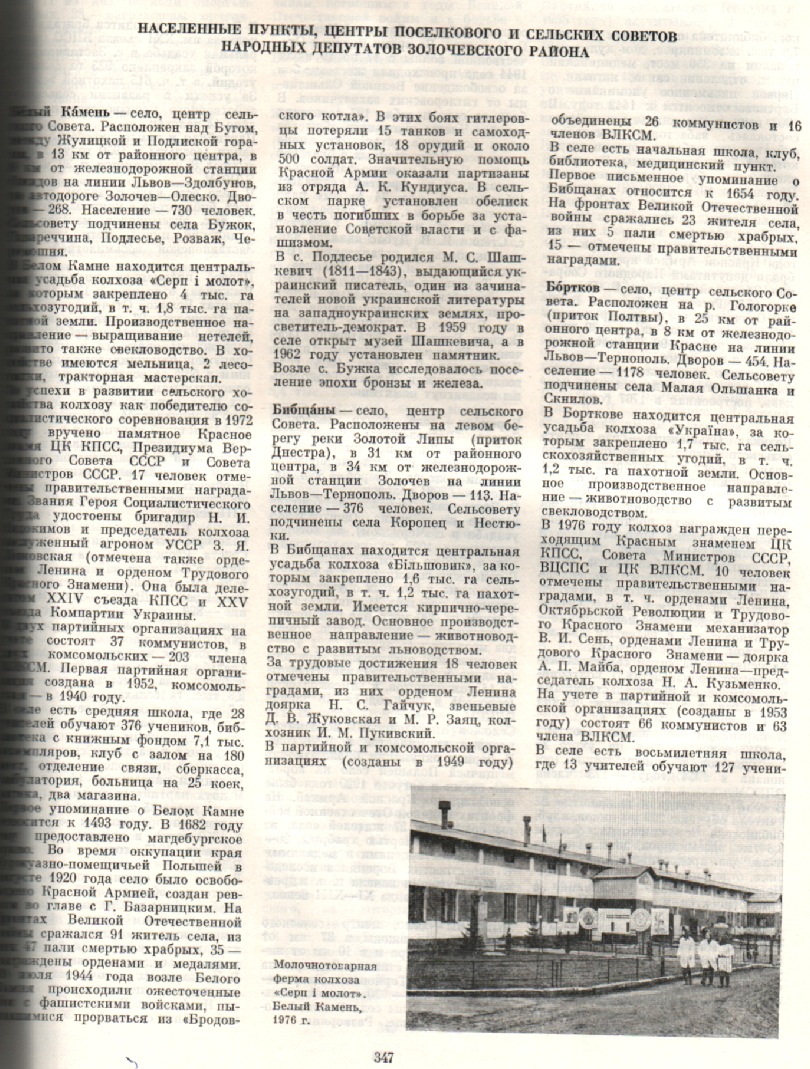
Bilyi Kamin / Білий Камінь
(in Polish it is known as Biały Kamień)
Page 347 at the end of the Zolochiv District.
Note: Since this is taken from the 1978 Russian language edition, all of the geographic references are transliterated from the Russian
Belyj Kamen’
Village, center of Village Soviet<political entity>. Set on the Bug River, between the Zhulitsky and Podlisky Mountains. 13 km from the district center of Zolochev, 8 km from the Ozhidov train station on the Lvov-Zdolbunov line, and on the Zolochev-Olesko highway. 268 homesteads and a population of 730.
Also belonging to the Belyj Kamen’ Village Soviet are the villages of Buzhok, Gavarechchina, Podles’e, Rozvazh, and Cheremoshnya.
In Belyj Kamen’ is the Collective Farm Center of "Sickle and Hammer," which contains 4,000 hectares of collective farmland and 1,800 hectares of plowed land. Production trends include raising calves and a developing sugarbeet crop. The collective farm consists of a mill, 2 sawmills, and a tractor workshop.
In 1972 Belyj Kamen’ was handed the memorable award of the Red Banner of the Central Committee of the Communist Party of the Soviet Union, Presidium of the Supreme Soviet of the USSR, and of the Soviet of the Ministers of the USSR, for its success at winning the socialist competition "Progress of the Agricultural Collective Farm." 17 people were honored with the government award. Title of the Hero of Socialist Labor was bestowed upon brigadier N.I. Evdokimov, while the Chairperson of the Collective Farm, Z. Ya. Lozhovskaya was merited with the honor Agriculturist of the Ukrainian Soviet Socialist Republic and awarded the Order of Lenin and the Order of Labor of the Red Banner. She was the delegate of the 24th Congress of the Communist Party of the Soviet Union and the 25th Congress Party of the Ukrainian Soviet Socialist Republic.
There is a count of 37 official communist party members in 2 party organizations. There are 203 members in 2 Komsomol<Communist Youth Organization>. The first party organization was created in 1952, the first Komsomol in 1940.
In the village is a high school, where there are 28 teachers and 376 pupils, a library with a collection of 7,100 volumes, a club with a 180 seat auditorium, a branch of communication services, a savings bank, an outpatient clinic, a hospital equipped with 25 beds, a pharmacy, and 2 stores.
Belyj Kamen’ was first mentioned in the chronicles in 1493. In 1682 it was allowed into the Magdeburg Law. During the occupation of bourgeois-landlord Poland the village was liberated by the Red Army in August 1920 and created a Revolutionary Committee headed by H. Bazarnitsky.
91 village citizens were victims on the front during the Great Patriotic War (World War II), of which 47 courageously lost their lives. 35 were awarded orders and medals. On July 20, 1944, near Belyj Kamen’ were fierce battles against the fascist armies in an attempt to break out of the "Brody Broiler"<scene of a great clash between the two armies.> In the battles the Hitlerites lost 15 tanks and transports, 18 heavy weapons, and nearly 500 soldiers. The partisans under A.K. Kundius offered significant help to the Red Army. In a park an obelisk was erected in honor of those fallen in the fight against the fascists.
In the village of Podles’e M.C. Shashkevich (1811-1843) was born. He was a prominent Ukrainian writer, one of the founders of the new Ukrainian literature in Western Ukraine, and an enlightened democrat. In 1959 a museum dedicated to Shashkevich opened in the village and in 1962 a monument was erected. Near the village of Buzhok a settlement form the Bronze and Iron Age was discovered.

www.halgal.com
Questions and Comments to Matthew
Bielawa
Copyright ©2002
All rights reserved